Oil Painting Color Techniques: Placement, Mixing on Palette, and Smart Blending for Realism
Placement of Color: The Power of Optical Mixing Over Physical Blending
Build Rich, Dynamic Color Through Subtle Variations
- Placement Of Color
- Mixing Color For An Oil Painting
- Blending Color In An Oil Painting
Placement of Color: The Power of Optical Mixing Over Physical Blending
The most effective method for blending color in an oil painting is not to blend the colors at all. Instead, it's better to place very similar colors side by side without mixing them. The key is to make small adjustments to the colors and arrange these similar shades next to one another. This way, when viewed from a distance, the colors will appear to blend in the viewer's eye.
Mixing Colors for Oil Painting: Small Adjustments and Palette-Only Mixing
When mixing colors for an oil painting, it's important to make small adjustments as you work across the form. This approach will yield a wide range of similar tones and values. By placing these similar colors next to one another, you create the illusion of three-dimensional form without actually blending the colors on the canvas.
Mix colors on your paint palette, not on your painting. Why? Mixing paint on the actual painting can result in muddy colors.
Why Over-Blending Flattens Form and How to Resist It
Blended colors can make a painting appear flatter. Instead, using colors placed closely together with subtle differences in value and color temperature can produce a richer, more dynamic effect. This is easier said than done. Our brain wants to blend the colors. Resist the urge.
Controlled Blending Techniques: Clean Dry Brush and Crosshatching Methods
When you want to blend colors, such as to create a softer edge, start by using a clean, dry paintbrush. Place the paint colors next to one another as described earlier. Then, with the bristles of a clean, dry paintbrush, quickly blend the edges of two colors. Use quick, short strokes, and try to resist the urge to over-blend, as this can flatten the form or give it an airbrushed appearance.
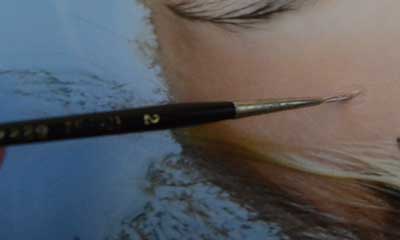
Another effective method for blending colors is crosshatching similar colors over one another. I prefer using a small round brush to pull one color through another, applying small strokes in one direction.
The Perceptual Science Behind Placement and Controlled Blending in Oil Painting
Placing similar colors side by side instead of physically blending leverages optical mixing. When adjacent hues and values are close enough (within the eye's resolution limit at viewing distance), the eye can perceive seamless gradients. Mixing pigments together can reduce saturation and visually flatten the form by eliminating micro-variations that signal curvature and depth. The brain's preference for subtle transitions stems from natural scenes: real surfaces exhibit small chromatic and luminance fluctuations. Frequent small adjustments across forms mimic these natural gradients, countering the brain's tendency to simplify. Look up gestalt grouping. The artist can increase perceived volume through preserving the edge information between colors. Controlled dry-brush or crosshatching softens transitions while retaining texture. Quick strokes minimize over-smoothing, preserving the details the visual system uses for shape-from-shading cues. Resisting the urge to over-blend aligns with perceptual expertise in realism: trained artists override top-down blending impulses to faithfully reproduce optical input, resulting in more convincing illusions.
I'm still working on this, fighting the urge to over blend.
Conclusion: Build Rich, Dynamic Color Through Subtle Variations
The best way to blend colors in oil painting is to create the illusion of blended color without actually doing so. Excessive blending can make a painting appear flat. Instead, it is better to make continuous, small adjustments to the paint color. Place these small areas of slightly different colors next to one another as you move across the form. If you need to blend colors to soften edges, use the bristles of a clean, dry paintbrush to quickly merge the two colors or sections together.
Related Topics:
Oil Painting How To