How to Make Oil Paint Dry Faster: Proven, Safe Techniques for Quicker Results
Why Oil Paint Dries Slowly (and Why That's Actually a Benefit)
Use Heat: The Safest & Most Natural Way to Accelerate Drying
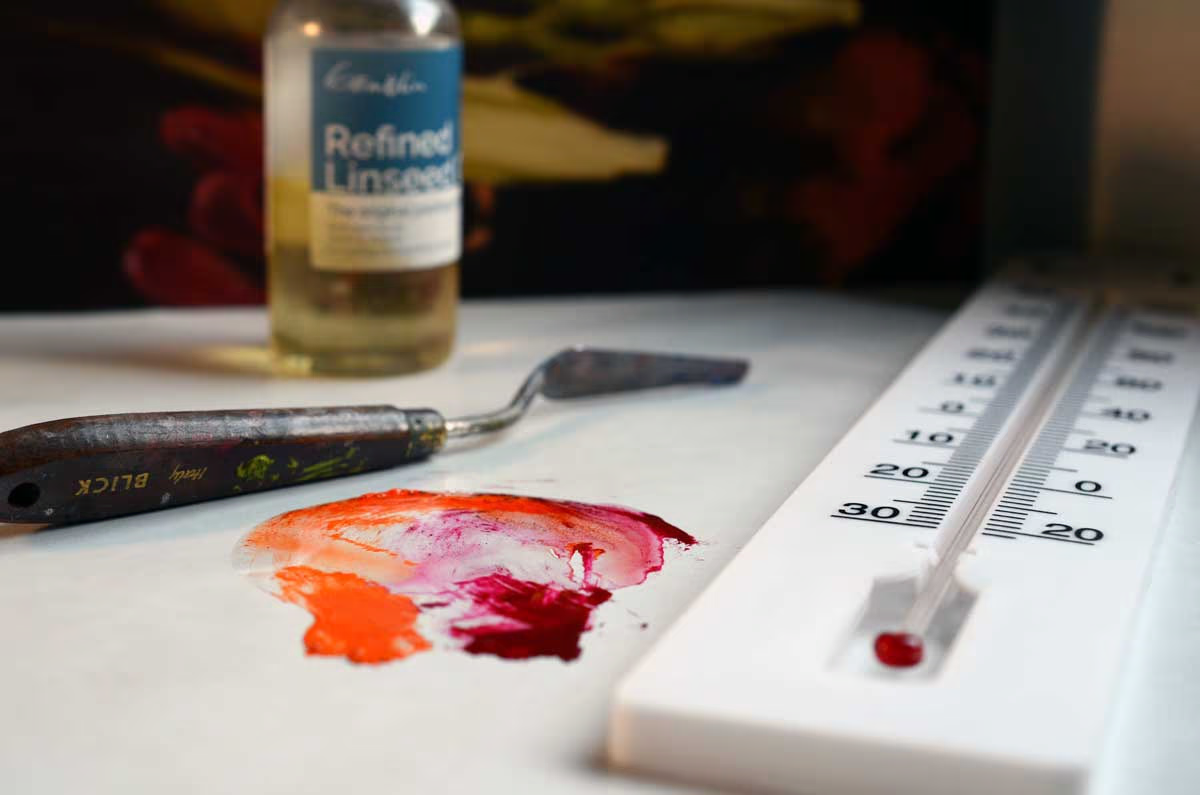
Here are 3 ways to make oil paint dry faster:
- Use Heat
- Quick-Dry Paint Mediums
- Paint In Thin Layers
Why Oil Paint Dries Slowly (and Why That's Actually a Benefit)
Oil paint dries through autoxidation: unsaturated fatty acids in linseed (or other drying oils) react with oxygen to form a cross-linked polymer film. This process is slow (days to weeks) because it requires oxygen diffusion into the paint layer. There are five common types of drying oils used for this purpose: linseed oil, walnut oil, safflower oil, poppyseed oil, and stand oil.
Among these, linseed oil is the most commonly used drying oil.
Oil paint is considered a slow-drying medium, drying more slowly than watercolor or acrylic paints. This longer drying time allows artists more flexibility to manipulate the paint before it sets, making it possible to blend colors and create effects that are difficult or nearly impossible to achieve with other mediums.
Temperature and humidity significantly affect how quickly oil paint dries. Research suggests that lower temperatures result in slower drying times, while higher temperatures can accelerate the drying process. I've experienced this firsthand when painting on a hot summer day: any uncovered paint on my palette dried overnight, making it unusable the next day. In contrast, when painting in the winter, uncovered paint may take nearly a week to dry.
Use Heat: The Safest & Most Natural Way to Accelerate Drying
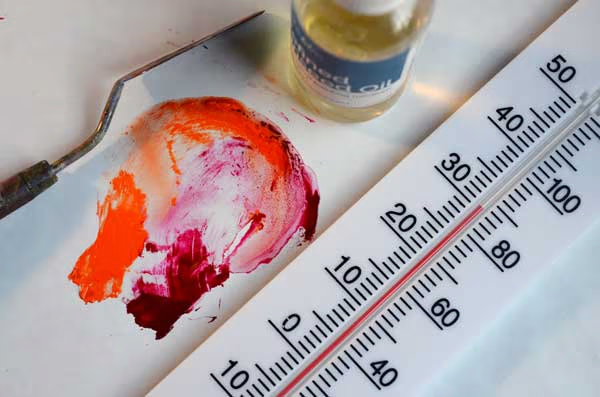
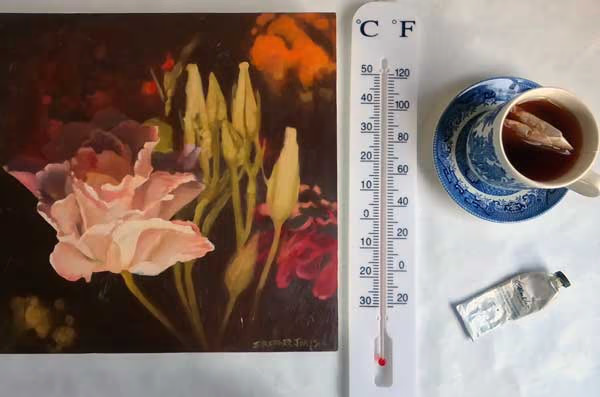
I prefer to use heat to speed up the drying process of oil paint. While additives can also help accelerate drying, they must be mixed into the paint before or during the painting process. Many of these additives, known as metal driers, can be toxic. Common types of metal driers include cobalt, manganese, and lead.
Using heat is a natural and easily accessible method to shorten the drying time of a completed painting. Heat accelerates the reaction rate, making warm rooms or sunlight effective without altering chemistry if kept moderate.
The drying of oil paint involves a multi-phase process known as autoxidation. The early phase, often called the induction or initiation phase, appears to be sensitive to heat. As the oil paint dries, it reaches a point similar to a gel point, causing the paint to thicken and its viscosity to increase.
Research suggests that increasing the ambient temperature to above room temperature can lead to an earlier gel point. Additionally, higher temperatures, such as 100 degrees Fahrenheit for example, may promote oxidation. However, researchers warn that high temperatures could change the structure of the paint film in unpredictable ways. The best option is to plan ahead and allow your oil painting to dry and cure naturally.
Fast-Drying Mediums & Additives: What Works and What to Avoid
Painting medium can be an additive to oil paint that aids in drying. There are various types of medium available, each with distinct properties.
Keep these tips in mind when using oil paint mediums: Different oil paint mediums can either slow down or speed up the drying time of oil paints. It's essential to read the information on each oil-based paint-drying accelerator before incorporating it into your artwork. Cobalt Drier is a substance that can be added in small amounts to an oil paint medium before combining it with paint to speed up the drying time. However, it should be tested first before being used in a painting. I haven't personally used safflower oil or Cobalt Drier, as I prefer to keep my process simple.
If you choose a painting medium, select one with the desired drying properties. Some mediums are slow-drying, while others speed up the drying time of oil paint. Read the labels and choose accordingly.
Paint in Thin Layers: Thicker Paint = Much Longer Drying Time
Consider applying paint in thin layers. Thin layers increase surface area exposed to air, enabling quicker oxygen absorption. In contrast, thicker paint layers limit oxygen penetration, dramatically extending drying time and risking wrinkling or cracking. Using thin layers of oil paint can significantly accelerate the drying process.
How to Make Oil Paint Dry Slower (When You Want More Blending Time)
If you want your oil paint to dry more slowly, consider adding a few drops of poppyseed oil as you mix your paint on the palette. Poppyseed oil is known for being one of the slowest-drying oils.
Using too much oil can result in a tacky finish on your painting. Although tacky oil-based paint may eventually dry, this isn't always guaranteed, and the drying process depends on the cause of the tackiness. In the past, I thinned my paint with excessive oil, which left a surface that remained tacky for years. It's crucial to use only the necessary amount of oil; keep it minimal.
Using minimal linseed oil helps preserve flexibility in the upper layers, in line with the fat-over-lean principle. While additional oil can increase plasticity, it also slows down the initial oxidation process.
Common Problems: Tacky Paint, Hair Dryer Risks, and Why It Won't Dry
Can I Dry My Oil Painting With A Hair Dryer?
While oil paint may dry faster with a hair dryer, excessive heat may cause paint defects such as bubbling and cracking.
Why Won't My Oil Paint Dry?
If your oil paint won't dry, too much painting medium or oil has likely been added to the paint. Humidity may also affect paint drying time. Remember to be patient because oil paint often dries slowly.
It's important to plan and avoid rushing the process. Painting well in advance of deadlines ensures that the paint will be dry to the touch, as oil paints can take a long time to dry.
Conclusion:
You can speed up the drying time of oil paint using several straightforward methods. One of my favorite techniques is applying heat, as it is safe and natural, unlike some mediums.
DePolo et al. (2024)
DePolo, G., Iedema, P., Shull, K., & Hermans, J. (2024). Comprehensive characterization of drying oil oxidation and polymerization using time-resolved infrared spectroscopy. Macromolecules, 57(17), 8263–8276. https://doi.org/10.1021/acs.macromol.4c01164
Open access full-text PDF: Download here (ACS Publications, CC-BY 4.0)
This study uses time-resolved infrared spectroscopy to detail the two-stage autoxidation and polymerization of drying oils like linseed oil. It shows how heat accelerates the initial (pre-gel) fast curing phase by speeding hydroperoxide decomposition and reducing induction time, while the slower post-gel stage is less temperature-dependent due to diffusion limits—directly relevant to understanding and controlling drying times in realistic oil painting.
de Viguerie et al. (2016)
de Viguerie, L., Payard, P. A., Portero, E., Walter, Ph., & Cotte, M. (2016). The drying of linseed oil investigated by Fourier transform infrared spectroscopy: Historical recipes and influence of lead compounds. Progress in Organic Coatings, 93, 46–60. https://doi.org/10.1016/j.porgcoat.2015.12.010
Open access full-text PDF: Download here (HAL/Sorbonne Université archive)
Lead compounds have been commonly used since the Renaissance to increase the drying properties of oils. Using Fourier transform infrared spectroscopy (FT-IR), this study investigates the effects of lead oxide (PbO) on linseed oil drying. It monitors changes via key absorption bands (e.g., ν(OH) at 3500 cm⁻¹ and ν(CH) in cis C=C at 3010 cm⁻¹). Results show PbO accelerates drying and reduces induction time (by a factor of 4 with 5% PbO) without major mechanism changes. An optimal amount of 5% PbO is identified (vs. 1% or 20%). Historical recipes are reviewed, and parameters like heating during PbO addition and water effects are examined. Keywords: Oil paint; Drier; Litharge; Attenuated total reflection–Fourier transform infrared; Oxidative polymerisation.
van den Berg (2002)
van den Berg, J. D. J. (2002). Analytical chemical studies on traditional oil paints [Doctoral dissertation, University of Amsterdam]. UvA-DARE Digital Academic Repository. https://hdl.handle.net/11245/1.200950
Open access full-text PDF: Download here (University of Amsterdam repository)
This doctoral thesis provides in-depth analytical chemical investigations of traditional oil paint systems, including the developmental stages from oil to hard dry films, effects of processing methods on linseed oil composition, mass spectrometry of constituents and aged paints, GC/MS identification of compounds, hydrolysis degree determination, and studies on bloom formation in primed canvas and paint layers in works of art. It forms a foundational reference for understanding the chemistry of historical and traditional oil paints.
Related Topics:
Oil Paint Dry Faster