Step-by-Step Guide to Drawing a Realistic Eye: Proportions, Shadows, and Refinement
Sketch the Large Shapes: Upper Eyelid, Corners, and True Angles
Map Out Shadow Shapes Precisely for Likeness
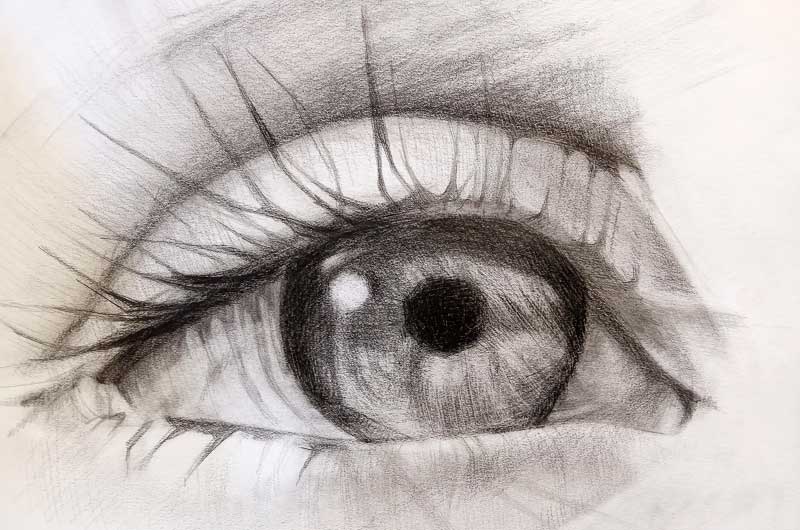
- Loosely sketch eye socket
- Sketch the large shapes
- Break the large shapes into smaller shapes
- Map out the shadow shapes
- Shade the shadow shapes
- Blend and refine
- Add the details
Progression Images: From Initial Sketch to A Finished Realistic Eye
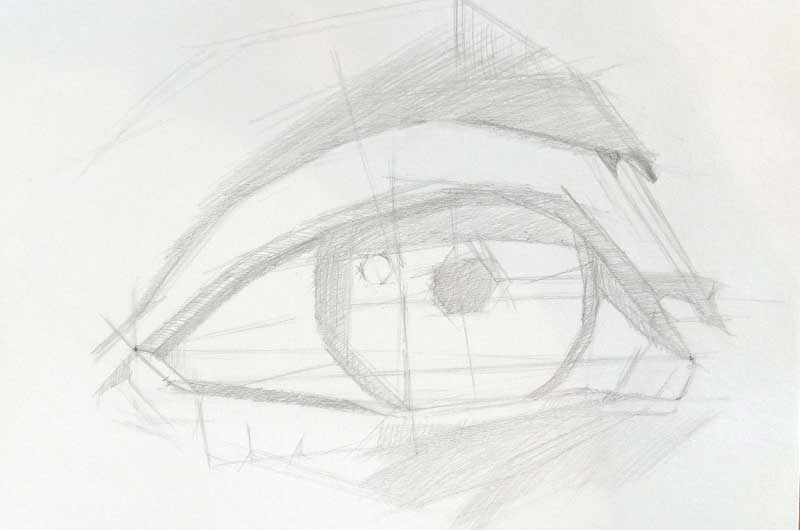
Begin by sketching the largest shapes.
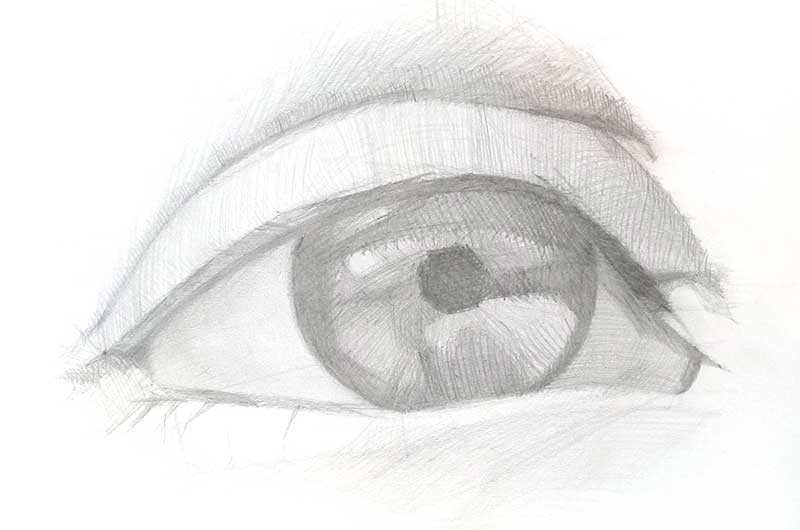
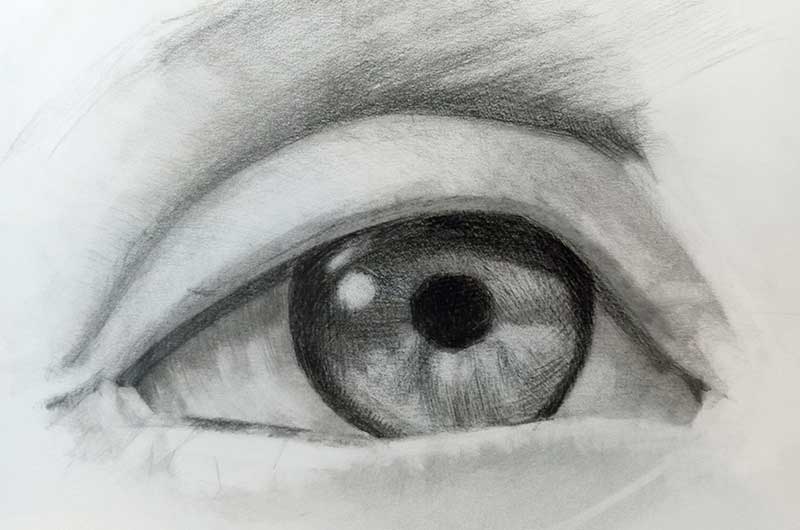
Start shading the eye.
Finished sketch of an eye.
Loosely Sketch the Eye Socket as a Proportion Container
Start by loosely sketching the eye socket to outline the outer bounds of the eye. Think of this as a container that will hold the final drawing. If the drawing extends beyond the container, it's likely growing out of proportion. This sketch helps to keep the drawing in proportion and place the eyebrow in the correct position.
Sketch the Large Shapes: Upper Eyelid, Corners, and True Angles
Next, sketch the large shapes that make up the eye, such as the upper eyelid and the outer corners. Try to copy the angles and shapes as closely as possible to what you see, and avoid simplifying the eye into a generic shape like an almond.
Break Large Shapes into Smaller, Accurate Sections
Then, break down the large shapes into smaller sections, observing the smaller shapes, lights, and shadows. Pay attention to the thickness of both eyelids, the edges, and the complexity of the corners of the eye.
Map Out Shadow Shapes Precisely for Likeness
Outline the shadow shapes lightly, drawing them exactly as you see them. It's important to focus and draw these shapes exactly as they appear to capture a likeness.
Shade Shadow Shapes Lightly and Match Observed Values
Slowly shade the shadow shapes, working very lightly and carefully to match the values to what you see. Double-check the shapes often and observe the details closely.
Blend and Refine: Control Mid-Tones and Avoid Over-Blending
Blend and refine the shadows, being careful not to over-blend which can make the drawing look flat. Soften the mid-tones where light meets dark, and consider lifting out lights with a kneaded eraser.
Add Final Details: From Initial Sketch to Finished Realistic Eye
Finally, add the details such as highlights, eyelashes, and necessary sharp lines to complete the drawing of the eye. You can draw the eye as loosely or as refined as you like.
The Perceptual Science of Drawing Realistic Eyes
Drawing eyes realistically taps into advanced principles of visual perception and neuroscience. The eye socket container technique counters size constancy and shape illusions. Our brains often exaggerate or simplify facial features based on assumptions about 3D structure. Starting with an enclosing shape forces objective proportion measurement. Accurate angle copying and shadow shape mapping exploit edge- and boundary-detection, where luminance contrasts define form. Replicating observed shadows precisely trains better discrimination of subtle value gradients that convey curvature of the eyeball and eyelids. Controlled blending of mid-tones preserves the natural soft-to-hard transitions our visual system uses to infer specular highlights and form shadows, avoiding the flattening effect of over-smoothing that disrupts gradient-based depth cues. Highlight placement on the cornea mimics real optical phenomena (specular reflection), triggering the brain's recognition of wet, reflective surfaces. Studies on portrait artists show that trained realists develop superior perceptual discrimination for faces, allowing them to prioritize relational value shapes and angles over symbolic features like "almond" eyes—resulting in higher accuracy and likeness (Chamberland et al., 2016).
Chamberland, C., et al. (2016). Outlining face processing skills of portrait artists: Perceptual experience with faces predicts performance. Vision Research, 126, 1–12.
https://doi.org/10.1016/j.visres.2016.05.018
Full paper (may require access): ScienceDirect link
Free PDF (author-uploaded): ResearchGate PDF
Related Topics: