Step-by-Step Guide to Drawing Realistic Lips: Proportions, Shadows, and Natural Rendering
Sketch the Large Shapes: Upper Lip, Lower Lip, and True Angles
Map Out Shadow Shapes Precisely to Capture Likeness
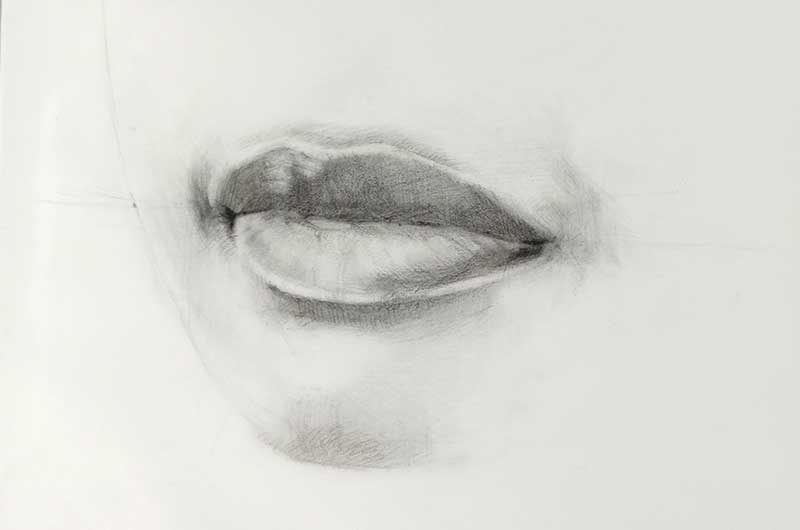
- Loosely sketch the mouth line
- Sketch the large shapes
- Break the large shapes into smaller shapes
- Map out the shadow shapes
- Shade the shadow shapes
- Blend and refine
- Add the details
Progression Images: From Initial Mouth Sketch to Finished Realistic Lips
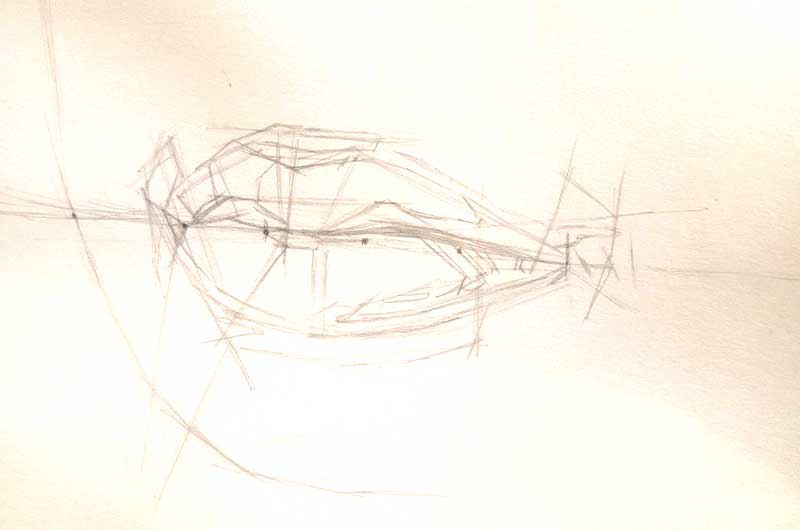
Begin by sketching the largest shapes.
Loosely Sketch the Mouth Line and Face Bounds for Accurate Placement
Start by loosely drawing the mouth line and the outer bounds of the face shape to help with placement and size.
Sketch the Large Shapes: Upper Lip, Lower Lip, and True Angles
Next, sketch the large shapes that form the mouth, such as the upper lip, lower lip, and outer corners, focusing on copying the angles and shapes as closely as possible.
Break Large Shapes into Smaller, Detailed Sections
Break down the large shapes into smaller sections, paying attention to the smaller shapes, lights, and shadows, as well as the height and width of both lips.
Map Out Shadow Shapes Precisely to Capture Likeness
Outline the shadow shapes lightly and draw them exactly as you see them to capture a likeness.
Shade Shadow Shapes Slowly: Match Values and Avoid Distinct Outlines
Slowly shade the shadow shapes by matching the values to what you see and avoid over-blending which can make the drawing look flat. Remember that lips do not have a distinct outline.
Blend and Refine: Soften Mid-Tones and Lift Highlights
Blend and refine the shadows carefully, and consider lifting out lights with a kneaded eraser. Soften the mid-tones where light meets dark.
Add Final Details: Highlights, Sharp Edges, and Texture
Finally, add details such as highlights and necessary sharp lines to complete the drawing of the lips. You can draw a mouth as loosely or as refined as you like.
The Perceptual Science of Drawing Realistic Lips
Drawing lips realistically engages key mechanisms of visual perception and shape constancy. The initial loose mouth line and bounding sketch counteract facial feature exaggeration biases. Our brains often distort lip proportions due to symbolic knowledge ("lips are bow-shaped") rather than observing what we see. An enclosing container promotes objective size and placement comparison. Accurate angle copying and shadow shape mapping leverage luminance edge detection and gradient processing in higher visual areas. Lips derive form almost entirely from subtle value transitions rather than hard contours, as human skin lacks strong outlines under typical lighting. Replicating observed shadows trains the artist to override assumptions and record true gradients. Controlled blending preserves the soft mid-tone gradients our visual system interprets as curvature and volume on curved, moist surfaces. Strategic highlight placement mimics specular reflections on hydrated tissue, triggering rapid recognition of "wetness" and three-dimensionality. Studies of portrait drawing accuracy show that prioritizing relational value shapes over linework may significantly reduces errors in likeness, as it aligns more closely with how the brain reconstructs facial form from light patterns rather than categorical features (Cohen & Jones, 2008).
Cohen, D. J., & Jones, H. E. (2008). How shape constancy relates to drawing accuracy. Psychology of Aesthetics, Creativity, and the Arts, 2(1), 8–19.
https://doi.org/10.1037/1931-3896.2.1.8
Full free PDF: https://people.uncw.edu/cohend/research/papers/cohen%20and%20jones%20-%20aca-2-1-8.pdf
Related Topics: