3 Key Shading Techniques to Make Your Drawings Look 3D
Why Realistic Shading Feels Hard (and How These Three Techniques Fix It)
Gradually Build Shadows in Layers for Natural Depth
Why Realistic Shading Feels Hard (and How These Three Techniques Fix It)
For years, my drawings appeared cartoonish rather than realistic. I struggled to understand why I couldn't draw objects that looked three-dimensional. Despite my efforts to shade properly, things still didn't seem right. It wasn't until I learned three key concepts that my drawings began to take on a more realistic quality. It's still a work in progress.
Here are three techniques that can help your drawings appear more three-dimensional:
- Gradually build up shadows in layers
- Keep light areas light
- Blend the mid-tones
Gradually Build Shadows in Layers for Natural Depth
Begin by building up shadows gradually in layers. Avoid going dark all at once. It's best to shade softly, using light lines or gentle cross-hatching. Make your marks wrap around curved forms, ensuring they follow the direction of the curves. When shading, it can be tempting to apply dark tones too quickly. If your darks are overly intense and your lights are too bright, your drawing may end up looking cartoonish. Values in nature are subtle, so it's important to shade gradually. Use light, thin strokes and gradually build up layers of charcoal or graphite, making small adjustments as you progress.
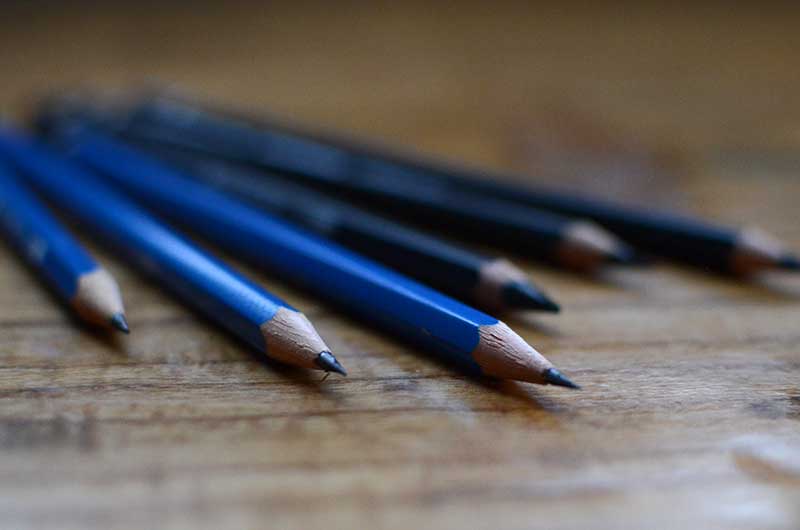
Use Sharp Pencils for Precise, Delicate Layering
Always keep your pencils sharp, as a fine point allows for lighter, more delicate marks. Be sure to re-sharpen your pencil frequently while you draw.
Preserve Light Areas: Keep Highlights Clean and Bright
The color of the paper often serves as the highlights and lightest parts of a drawing, unless you add white charcoal. If you're using white paper, it's best to maintain the lightest areas as pure white. Avoid staining them. Graphite and charcoal can embed themselves into the paper fibers, making them extremely difficult to erase. So, do your best to preserve the paper color in the lightest sections of your drawing. Make sure to keep them clean and free of any color.
Blend Mid-Tones for Smooth, Realistic Transitions
Blend the mid-tones effectively, placing special emphasis on where light meets shadow. Visualize a distinct line that separates light from dark. Instead of shading all the way to this line, leave a slight gap and gently blend the shadow towards the boundary for a softer transition. You can use a blending tool or a clean, soft brush to extend the pigment toward that boundary.
If the object you're working with has curves or rounded forms, the edges may be soft and subtle; try to replicate the shadows as you observe them. For soft edges, create smoothly blended transitions, and for hard edges, leave them sharply defined.
Draw What You See: Observe Shadows, Edges, and Subtle Variations
Always aim to draw what you see. Take the time to look closely and relax your gaze; search for shadow within shadows and replicate them accurately. Avoid over-blending, and reserve the majority of blending for the mid-tones while building up shadows in layers.
The Perceptual and Motor Science Behind Effective Shading Techniques
These shading methods align with how the visual system and motor control build three-dimensional perception from a flat surface. Gradual layering exploits the brain's sensitivity to subtle luminance gradients. Our visual system detects fine value transitions that signal curvature and depth via shape, from-shading cues. Slow buildup of shadows mimics natural light. Preserving pure light areas leverages high-contrast anchoring. Pure white paper reflects maximum luminance, creating specular highlights and expanding dynamic range. Accidental staining of the paper reduces this contrast, flattening the form as the eye loses reference for brightest values. Sharp pencils enable precise, low-pressure marks. Sharp points minimize tip deformation under force, reducing unintended darkening and improving edge acuity that the brain uses for boundary detection. Mid-tone blending preserves soft transitions critical for inferring surface curvature. Over-blending averages values into uniformity, eliminating high-frequency gradients that used to reconstruct 3D shape. Controlled blending (e.g., short strokes or tools) maintains just enough texture to suggest form without airbrushed flatness. Wrapping strokes around forms reinforces perceived volume through consistent directional cues. Together, these techniques help achieve more convincing illusions of depth and materiality in realistic drawing.
Conclusion: Practice These Steps for Convincing Three-Dimensional Form
Give these techniques a try, and I hope they help you shade your drawings to achieve a more three-dimensional effect.
Related Topics:
Envelop Method
Drawing With Angles
Shading A Drawing
Sighting Angles