How To Draw Step By Step With The Envelope Method
How to Use the Envelope Method for Realistic Drawing
Using the envelope technique in realistic drawing.
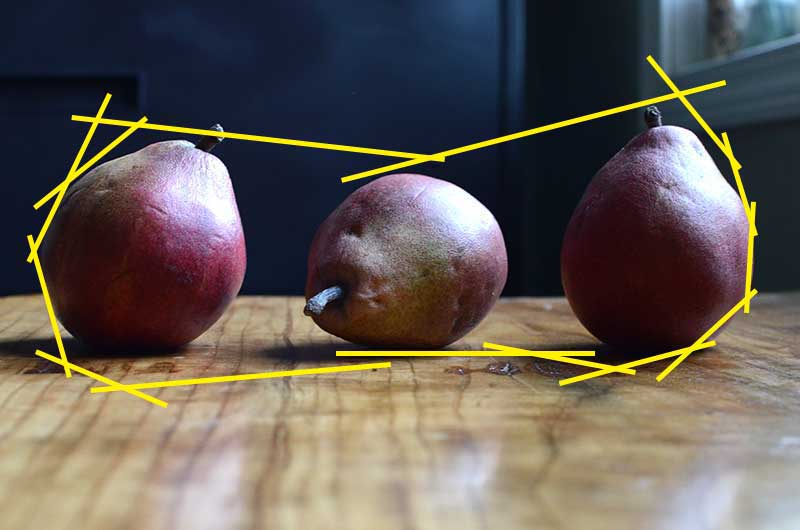
I’m sharing one of the best drawing secrets I’ve ever learned. It’s called the envelope (or container) method, and it helps you avoid the most common beginner mistake: drawings that grow out of proportion.
What Is the Envelope Method? (Container Technique Explained)
Let’s get started! The envelope method is a classical technique that can be used in observational drawing. But why do we begin a realistic drawing this way? When we start by sketching an envelope or container, we tend to focus on the whole rather than individual parts. This is important because drawings can often grow out of scale and proportion.
Preventing disproportionate growth right from the beginning helps improve accuracy. If the container is the right size and shape, then the elements drawn inside are more likely to be proportionate.
Set Up Your Still Life - View The Entire Scene As A Whole
Arrange simple objects (e.g., pears). Visualize the entire group as one cohesive object. This mindset helps you see the whole before the parts.
Place Key Dots on Important Points
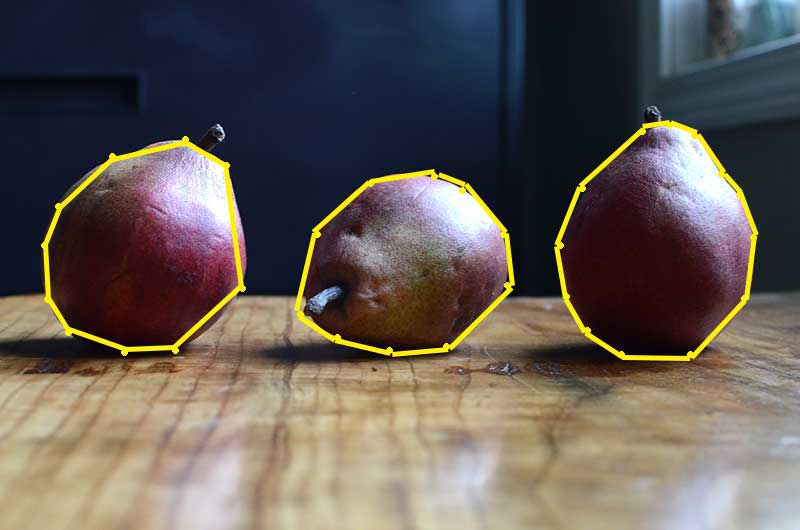
Lightly mark dots only at the highest, lowest, widest, narrowest, and most prominent features of the subject. These act like coordinates on a map — focus on accuracy, not quantity.
Connect Dots with Straight Lines Using Pencil Sighting
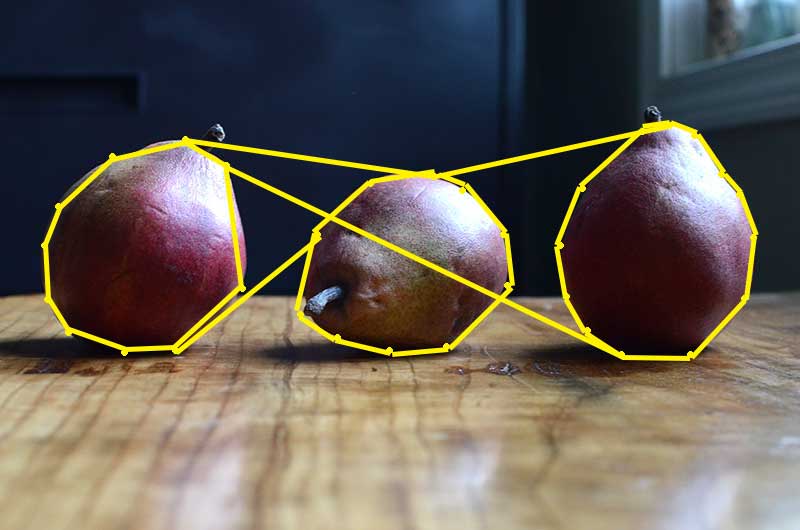
Hold your pencil at arm’s length and align it with an observed angle between two dots. Transfer that exact slant to paper using straight lines. Draw slowly — replicate slants and obliques precisely for correct size and position. By starting with an overall container shape, we can better constrain the elements of our drawing and maintain accurate proportions.
Check and Adjust the Envelope
Measure height vs. width of the envelope. Is it too tall? Too wide? Tweak until the container matches the subject’s overall shape. This step locks in proportion before adding details. This principle applies whether you are drawing a still life or a portrait.
Draw Inside the Envelope
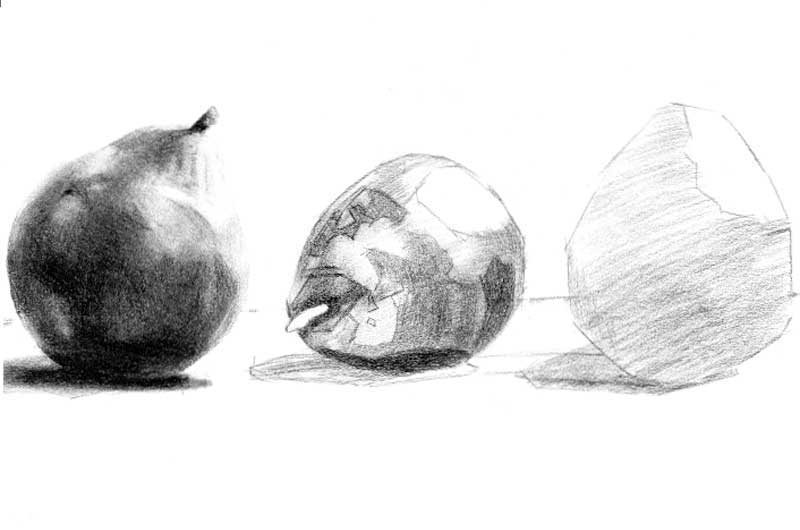
Once the envelope is accurate, sketch the largest shapes first using straight lines. Extend angles across objects to keep everything relational and proportionate. Everything you draw should fit inside this envelope.
Refine Progressively
Next, map shadow shapes lightly. Add details only after proportions and shadows are correct. Extra lines will blend into the final drawing — don’t worry about them messing up the paper.
The Perceptual Science Behind Angle Sighting & the Envelope Method
Research suggests that improved drawing ability may be linked to better shape perception. The envelope method addresses common biases in perception that lead to proportion errors in drawing. Our brains often exhibit size constancy, a phenomenon in which we perceive objects as being the same size, even when they appear different due to their distance. This can lead to perceptual errors, where we misinterpret what we see. This can potentially result in exaggerated or distorted features, especially when we focus on individual parts rather than the whole image.
By using the envelope method, we can develop "perceptual flexibility". This approach allows us to adjust our attention as needed, shifting back and forth between focusing on overall shapes and details as our drawing progresses. The envelope technique helps us establish overall measurements from the beginning. These overall measurements are considered global, while specific details are viewed as local elements. By concentrating on the complete picture from the outset, we can counteract certain perceptual illusions. We define an overall boundary early in the drawing process, and by copying outer angles with straight lines, we can combat our brain's natural tendency to create smooth, curved outlines.
Measuring the dimensions of the envelope leverages our brain's capacity for comparative judgment. This helps us reduce errors in estimation. Using the envelope technique gives us a way to set up our overall measurements right from the start. By keeping an eye on the big picture from the beginning, we can avoid some common visual tricks our brains play on us. We figure out the main boundary early on, leading to a more convincing representation of scale, proportion, and overall realism right from the initial strokes of the pencil.
Conclusion
The envelope method is a powerful foundation for realistic drawing. It keeps proportions believable, prevents part-by-part distortion, and trains you to see the whole first. Give it a try on your next still life or portrait — I’m rooting for you!
Want to go deeper? Explore triangulation in drawing for advanced angle-based techniques.
Sources & Recommended Reading
Robles, K. E., Bies, A. J., Lazarides, S., & Sereno, M. E. (2022). The relationship between shape perception accuracy and drawing ability. Scientific Reports, 12, Article 14900. https://doi.org/10.1038/s41598-022-18858-6
Free full-text PDF: https://www.nature.com/articles/s41598-022-18858-6.pdf
Cohen, D. J., & Bennett, S. (1997). Why can't most people draw what they see? Journal of Experimental Psychology: Human Perception and Performance, 23(3), 609–621. https://doi.org/10.1037/0096-1523.23.3.609
Free full-text PDF (author-archived): https://people.uncw.edu/cohend/research/papers/cohen%20and%20bennett%2097.pdf
Related Topics:
Sighting Angles
Drawing With Angles
Shading A Drawing
Drawing 3D