Core Palette for Flesh Tones: Venetian Red, Raw Sienna, Flake White Replacement
Creating the Base Flesh Tone and Tints/Shades
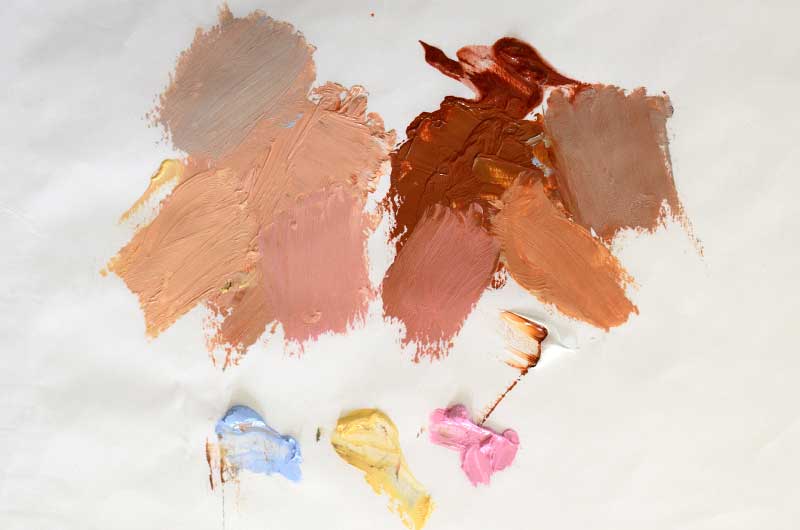
Core Palette for Flesh Tones: Venetian Red, Raw Sienna, Flake White Replacement
- Venetian Red
- Raw Sienna
- Flake White Replacement
- French Ultramarine Blue
- Terre Verte
Additional Colors for Temperature and Blush Control
- Radiant Blue
- Naples Yellow
- Cadmium Red Light
- Permanent Rose
Creating the Base Flesh Tone, Tints, & Shades
Venetian Red and Raw Sienna can be combined to create a flesh color base. Adding white produces various tints and shades of flesh tone.
These skin-tone shades can be used to paint large flat areas of color.
Adjusting Color Temperature as You Paint
As your painting progresses, you can adjust these shades to represent the warmth of the light that shines on your subject. The base skin tone can be altered by adding Radiant Blue or Naples Yellow to adjust the color temperature.
Adding Blush and Pink Accents: Cheeks, Lips, and Nose
You can also add small amounts of Cadmium Red Light or Permanent Rose to create pink tones. Pink tones are usually applied to the cheeks, lips, and nose among other places.
Mixing Shadows: Cooler, Deeper Tones with Terre Verte and Ultramarine
Venetian Red and Terra Verte can be combined to create a shadow color. Adding a small amount of French Ultramarine Blue can make the shadow color darker and deeper.
The Perceptual and Pigment Science of Mixing Flesh Tones
Realistic flesh tone mixing reflects the complex optics of human skin and pigment-subtractive behavior. Skin's appearance arises from subsurface scattering: light enters the epidermis, scatters in the dermis (rich in blood and hemoglobin with reds/pinks), and reflects back modulated by melanin (yellow-browns) and collagen—creating desaturated, multi-hued gradients with warm highlights and cooler shadows under typical lighting. The base Venetian Red + Raw Sienna, a yellow-brown earth, approximates this average reflectance, while Flake White Replacement (titanium-zinc blend) lightens value without cooling excessively, preserving natural warmth. Temperature adjustments exploit chromatic adaptation: Radiant Blue shifts toward cooler blue-violet to counter warm light's yellow bias in shadows (simultaneous contrast), while Naples Yellow adds yellow to enhance warmth. Blush accents (Cadmium Red Light or Permanent Rose) target hemoglobin-rich zones. Adding small additions of high tinting red prevents overpowering. Shadow deepening with Terre Verte and French Ultramarine introduces cool green-blue undertones that mimic venous blood and reduced light penetration, enhancing depth via value and hue contrast. Limiting to few pigments minimizes muddiness. Excessive color mixing can result in neutral gray. Allowing optical mixing on the canvas by placing similar colors next to one another instead of blending helps create perceptual richness akin to real skin's micro-chromatic noise. Practicing this often helps to train the artist to match what they see rather than symbolic averages for convincing, lifelike results.
Conclusion: Practice and Observation for Lifelike Skin Tones
Many paint color combinations can be used to create a flesh tone. This is just one example. This post shows how to mix flesh tones with oil paint using only a few colors. I hope you find it useful. With a bit of dedicated practice and eye training, you can learn to achieve realistic flesh tones with oil paint.
Related Topics:
Skin Tone Oil Paint
What Colours Make Skin Tones
What Colors Make Pink?
What Colors Make Flesh Color?